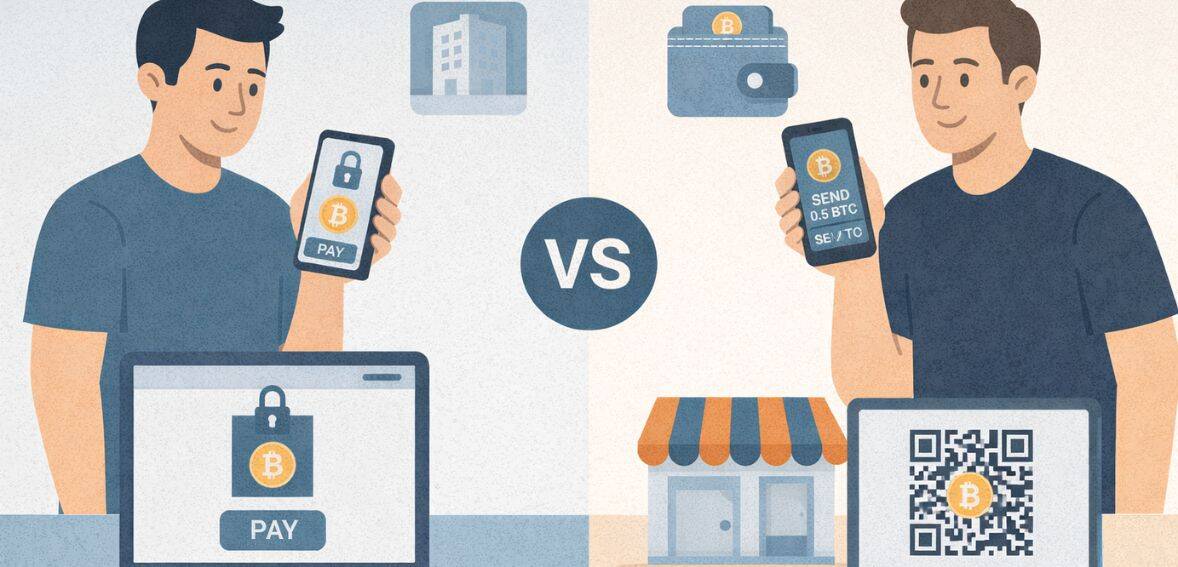
Crypto Payment Gateways vs. Direct Wallet Payments: Which Setup Fits Your Business?
Businesses looking to increase payment flexibility, lower cross-border friction, and reach a more international clientele are finding cryptocurrency payments to be an increasingly feasible choice. A crucial choice that many retailers must make as adoption increases is whether to take cryptocurrency directly through blockchain wallets or via a third-party payment channel.
Digital asset payments are made possible by both approaches, but they differ greatly in terms of setup, control, operational effort, client experience, and compliance duty. Selecting the best strategy has an impact on cash flow, risk management, and brand perception in addition to being a technical decision.
Businesses may make well-informed decisions that complement their objectives and capabilities by knowing how cryptocurrency payment gateways and direct wallet payments operate and where each works best.
Understanding the Two Models at a High Level

While direct wallet payments eliminate intermediaries and give the company complete control and accountability, cryptocurrency payment gateways serve as middlemen that abstract blockchain complexity by managing wallet interactions, exchange rates, confirmations, and occasionally fiat conversion.
While direct wallets offer complete custody and transparency at the expense of greater technical and security responsibility, gateways are similar to traditional processors and offer predictable settlement and compliance support. Although they support quite different operational models and risk profiles, both facilitate the acceptance of cryptocurrencies.
How Crypto Payment Gateways Actually Work
By creating payment requests, controlling wallet addresses, keeping track of confirmations, and alerting merchants when payments are finished, cryptocurrency payment gateways streamline blockchain transactions.
Additionally, many gateways offer dashboards, invoicing tools, customer support, and automatic crypto-to-fiat conversion, enabling businesses to profit from cryptocurrency payments without possessing digital assets. This strategy reduces the need for blockchain expertise while speeding adoption from the merchant’s point of view because it feels familiar and predictable.
How Direct Wallet Payments Function
Businesses must create and maintain their own wallets, accept on-chain payments directly, and independently monitor confirmations in order to use direct wallet payments.
Although this configuration offers the highest level of ownership and transparency, it necessitates transaction reconciliation, strong technical discipline, secure private key management, and frequently separate exchange integrations for fiat conversion. Although effective, this strategy requires maturity in security and infrastructure management and adds operational complexity.
Ease of Integration and Time to Market
Through platform plugins and APIs, crypto payment gateways enable quick deployment, enabling companies to accept cryptocurrency without the need for specialized expertise.
Longer implementation times are caused by the need for custom development, wallet management systems, and monitoring tools for direct wallet setups. Gateways are frequently preferred by companies that value simplicity and speed, whereas direct wallets may be chosen by those who are prepared to make infrastructure investments.
Control and Ownership of Funds
While direct wallet transfers offer immediate custody and complete control, gateways may retain or process money briefly until settlement, creating reliance and counterparty risk. Crypto-native companies find autonomy attractive, but it also gives the merchant complete control over asset security.
This choice revolves around the trade-off between convenience and sovereignty. Businesses looking to increase payment flexibility, cross-border crypto payments help lower friction and expand access for international customers.
Security Responsibilities and Risk Exposure
While direct wallet payments necessitate internal security controls, access management, backups, and incident response planning, gateways make significant investments in security infrastructure and monitoring, lowering risk for companies with minimal resources. By removing middlemen, third-party risk is eliminated, but internal exposure is much increased. As a result, security is no longer a delegated duty but rather a fundamental operational necessity.
Compliance and Regulatory Considerations

When deciding whether a direct wallet or cryptocurrency payment gateway is suitable for a company, compliance is crucial. By helping with reporting, transaction monitoring, and compliance procedures, crypto gateways frequently reduce regulatory pressure. This is particularly useful in jurisdictions with complicated or changing regulations.
Usually, they offer organized records that make tax reporting and audits easier. Direct wallet payments, on the other hand, transfer complete compliance responsibility—including transaction documentation, tax treatment, and regulatory interpretation—to the company.
Organizations having in-house legal experience and a solid grasp of cryptocurrency legislation are most suited for this strategy. While direct wallets need proactive compliance management, gateways provide convenience and assistance. Therefore, regulatory preparedness is a crucial consideration when selecting the appropriate arrangement.
Customer Experience and Trust
Any cryptocurrency payment strategy’s success is strongly influenced by the customer experience. Users with little experience with cryptocurrencies can utilize crypto payment gateways since they often offer simple checkout processes, unambiguous payment instructions, and support for a variety of cryptocurrencies.
Particularly for first-time cryptocurrency payers, this familiarity fosters trust and reduces hesitation. In contrast, direct wallet payments necessitate that clients directly transfer money to a wallet address, which may be frightening or dangerous for inexperienced users. Irreversible losses may also result from mistakes in network selection or wallet addresses.
While crypto-native audiences might appreciate the independence and openness of direct wallet transactions, businesses catering to a wide or mainstream audience frequently benefit from the assurance that gateways offer. Since many crypto payment gateways also support familiar options like digital wallet payments, they often feel more trustworthy and intuitive to mainstream customers exploring crypto checkout for the first time.
Transaction Fees and Cost Structure
Gateways and direct wallets have quite different pricing structures for cryptocurrency payments. Infrastructure, customer service, compliance support, and occasionally fiat conversion is all included in the processing fee that gateways normally charge. These charges reduce internal burden and provide certainty.
Gateway fees are eliminated with direct wallet payments, but internal expenses for development, security management, transaction monitoring, and reconciliation are added. Direct wallets may seem to have reduced transaction costs, but as volume increases and operational demands rise, the overall cost of ownership may rise.
Companies need to take into account both visible and hidden internal expenses. Transaction volume, technological capability, and the degree of operational complexity the company is ready to handle all influence the most economical choice.
Settlement Speed and Cash Flow Impact

Cash flow and operational flexibility can be greatly impacted by settlement speed. Depending on network circumstances, direct wallet payments enable businesses to receive funds as soon as transactions are verified on the blockchain, providing nearly instantaneous settlement.
Businesses that operate internationally or depend on quick cash may benefit from this. However, settlement timelines may be introduced by cryptocurrency payment gateways, especially when converting cryptocurrency into fiat money. These delays are not immediate, even if they are frequently less than those associated with traditional banking.
For accounting and forecasting, many firms prefer the predictability that gateways provide. Depending on whether a company values financial stability and simplicity of reconciliation or liquidity quickness, it might choose between instant access and a structured settlement.
Volatility Management and Pricing Stability
For many companies, cryptocurrency volatility continues to be a major issue. In order to safeguard profits and streamline financial reporting, payment gateways frequently lock exchange rates at the moment of purchase and automatically convert cryptocurrency into cash.
For companies that see cryptocurrency more as a payment mechanism than an asset, this strategy is perfect. If companies don’t actively manage conversions through exchanges, direct wallet payments expose them to price swings. Even though there is risk involved, companies that feel comfortable storing cryptocurrency as part of a larger treasury strategy may benefit.
Both operational preference and financial philosophy are reflected in the decision. Gateways are typically preferred by companies looking for stability, whereas direct custody may be preferred by those appreciating the long-term potential of cryptocurrencies.
Scalability and Operational Complexity
Scalability is about maintaining operational efficiency as traffic increases, not just managing more transactions. Because of its smooth scalability, cryptocurrency payment gateways can handle increases in transaction volume without the need for more internal resources. Updates, monitoring, and infrastructure are managed outside.
However, scalable internal procedures are required for direct wallet payments. Businesses must use automation, monitoring tools, and reconciliation systems as volume grows in order to avoid mistakes and bottlenecks. Operational pressure can compromise dependability in the absence of adequate planning.
Thus, organizational preparedness is just as important to scalability as technology. Gateways are frequently preferred by companies with lean teams, while direct wallet solutions may be effectively scaled by organizations with strong technological and operational capabilities.
Transparency and Auditability

One of the main benefits of blockchain-based payments is transparency; each model has a different way to access it. Payment gateways make financial tracking and reconciliation easier by abstracting blockchain data into dashboards and reports. This facilitates internal reviews and audits for non-technical teams.
Because direct wallet payments provide complete on-chain transparency, companies may independently confirm each transaction without depending on records from other parties. Organizations that value financial independence and auditability will find this level of visibility appealing.
However, knowledge and the right tools are needed to comprehend unprocessed blockchain data. Internal capabilities determine how much openness a company can really manage since transparency is most effective when combined with the capacity to understand and act upon it.
Brand Positioning and Strategic Messaging
A business’s acceptance of cryptocurrency conveys information about its goals and principles. Using a reputable payment gateway frequently conveys professionalism, dependability, and accessibility, which appeals to both general audiences and business clients. In contrast, direct wallet payments convey a dedication to crypto-native values, decentralization, and autonomy.
Communities that are interested in blockchain find this posture to be quite appealing. Whether on purpose or not, payment infrastructure decisions become a part of brand identity. Companies should think about how their payment system fits with their overall messaging and what customers anticipate. While alignment builds trust and supports the organization’s strategic narrative, a discrepancy between brand promise and payment experience can lead to uncertainty.
When Crypto Payment Gateways Make Sense

For companies that are new to cryptocurrency, have small technical teams, or operate in regulated contexts, cryptocurrency payment gateways are sometimes the best option. They provide consistent pricing, quick implementation, compliance assistance, and a comfortable checkout process.
When automated fiat conversion is allowed, gateways additionally reduce exposure to volatility. This strategy offers many companies a low-risk option to gauge crypto acceptability without having to commit to complicated infrastructure or asset custody.
E-commerce, SaaS, and service-based companies that value consumer convenience, operational effectiveness, and regulatory clarity above complete control over cryptocurrency assets are especially well-suited for gateways.
When Direct Wallet Payments Are the Better Fit
Organizations with significant technological skills, decentralized platforms, and crypto-native enterprises are the best candidates for direct wallet payments. This model offers independence from outside suppliers, complete custody, and transparency. It works well for companies that are at ease handling private keys, security procedures, and compliance internally and see cryptocurrency as more than just a payment option.
Audiences that appreciate liberty and on-chain communication are often drawn to direct wallets. Disciplined operating procedures and a readiness to take on more responsibility are necessary for this strategy, though. Direct wallet payments provide unparalleled control and conformity to decentralized principles for companies with long-term cryptocurrency objectives and the means to control risk.
Making the Right Decision for Your Business
Choosing between direct wallet payments and cryptocurrency payment gateways is a strategic choice that goes beyond technology. Customer demographics, risk tolerance, regulatory exposure, internal knowledge, and firm size all play a role. Both present operations and future expansion should be supported by the proper configuration.
Companies should consider what will be sustainable when transaction volume rises, and rules change, in addition to what is now easy. Financial processes, brand perception, and customer experience are all influenced by payment infrastructure. Making a deliberate choice guarantees that cryptocurrency payments provide a genuine benefit rather than an operational burden.
Conclusion: Aligning Crypto Payments with Business Reality
Direct wallet payments and cryptocurrency payment gateways are two different strategies, each with certain benefits and drawbacks. Direct wallets provide more emphasis on control, transparency, and independence than gateways do on ease of use, convenience, and compliance assistance. The optimal alternative depends on a company’s operational maturity, customer expectations, and long-term objectives; neither is intrinsically better.
Cryptocurrency payments acquire a significant competitive advantage when they are applied strategically as opposed to experimentally. Companies can reap the rewards of cryptocurrency while properly controlling risk and building enduring consumer confidence by matching payment infrastructure with practical requirements.
FAQs
What is the main difference between a crypto payment gateway and direct wallet payments?
A crypto payment gateway acts as an intermediary that simplifies transactions, compliance, and settlement, while direct wallet payments allow businesses to accept crypto directly on-chain with full control and responsibility.
Which option is better for businesses new to cryptocurrency?
Crypto payment gateways are usually better for beginners because they are easier to integrate, offer compliance support, and provide a familiar checkout experience for customers.
Are direct wallet payments cheaper than using a gateway?
Direct wallet payments avoid gateway fees but often involve higher internal costs for security, development, and operations, which can offset per-transaction savings.
How do these setups affect customer trust?
Gateways tend to build trust with mainstream users through guided checkout and support, while direct wallets appeal more to crypto-savvy customers who value autonomy and transparency.
Can a business use both gateways and direct wallets?
Yes, many businesses use a hybrid approach to balance convenience, control, and flexibility as their crypto payment strategy evolves.